

Everything about recycled paper and the sustainable alternative
Paper and recycling have gone hand in hand for over a thousand years. After it was discovered in ninth-century Japan that paper could be reused, the recycling of paper gained not only economic value but even sentimental value. For instance, in the 12th century, an emperor’s widow recycled all the poems and letters she had received from him after his death. She then wrote a poem on the recycled paper to commemorate him.
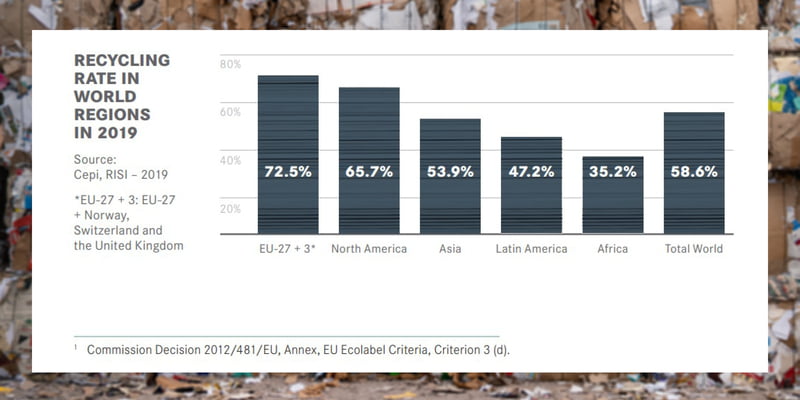
We never stopped recycling paper. Today, paper has a global recovery rate of 58.6%, and in Europe, we perform even better. Here, no less than 72.5% of paper is reused, meaning only 27.5% is lost (source). But why have we been recycling paper for so long and so eagerly? And after all these centuries of paper production, is recycling still the best environmental solution for producing paper?
WHAT IS RECYCLED PAPER?
Paper recycling is a process in which new paper products are made from waste paper. There are several categories of waste paper suitable for use as raw material for recycled paper:
– Mill broke: paper scraps and other paper waste left over during paper production, which is then recycled in the same paper mill. Thus, no paper is ever lost.
– Pre-consumer waste paper: manufactured paper products that have left the paper mill but never reached the consumer. It has therefore become waste paper before being used. Consider paper at printing houses that remains as cutting waste during production. Or paper that cannot be used by printers due to specifications (size, grammage). Pre-consumer paper made from trees is therefore unused and unprinted paper, without ink. Consequently, it does not cause pollution in the recycling process. This is the highest quality of recycled paper.
– Post-consumer waste paper: paper that is discarded by consumers and businesses after use, such as paper and paperboard packaging material, old newspapers, magazines, printing paper, envelopes, and beverage cartons. These types of paper always contain contaminants in the form of ink, staples, paperclips, glue, window film, polystyrene, food residues, dust, and sand, which do not actually belong with the waste paper.
EN 643: EUROPEAN STANDARD FOR DIFFERENT TYPES OF PAPER FOR RECYCLING
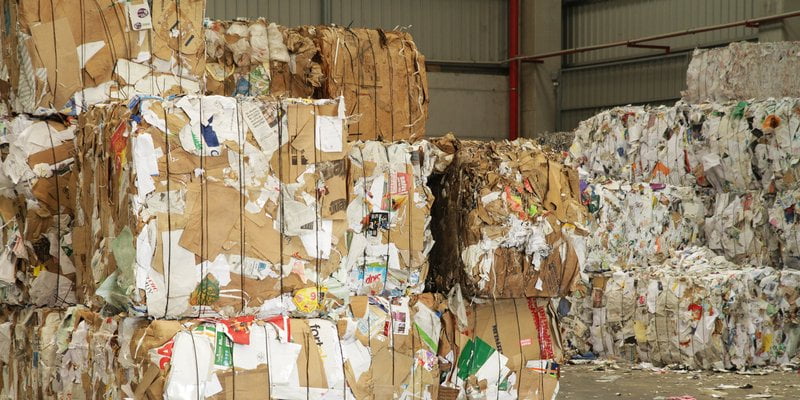
The European Union has compiled an overview of as many as 50 different types of recycled paper. This list is established in the EN 643 standard for various paper grades for recycling. After paper has been processed into packaging or printed matter, it can be recycled. Just as a baker can bake different types of bread (white, wheat, multi-seed), paper mills can produce different types of paper and paperboard (thick, thin, sturdy, flexible, strong, white, brown, etc.). A paper quality exists for every application. The quality of paper for a newspaper is completely different from that of a corrugated box, which in turn differs greatly from beverage cartons or printing paper.
Paper basically consists of cellulose fibers. This cellulose comes from various sources, such as different types of trees (eucalyptus, birch, pine, etc.). However, cellulose also comes from agricultural waste—stems and leaves left over after the harvest of wheat, barley, rice, sugarcane, and other crops. All these cellulose fibers have different properties and characteristics. This allows the paper industry to produce various types of paper and paperboard from different types of recycled paper. The EN 643 standard helps paper recycling companies and paper mills sort the different types of waste paper. Each quality has a different price and different characteristics. This EN 643 standard allows more paper to be recycled, increases the quality of the recycled paper, and enables the production of higher-quality paper and paperboard packaging and printed matter.
WHY IS PAPER RECYCLED?
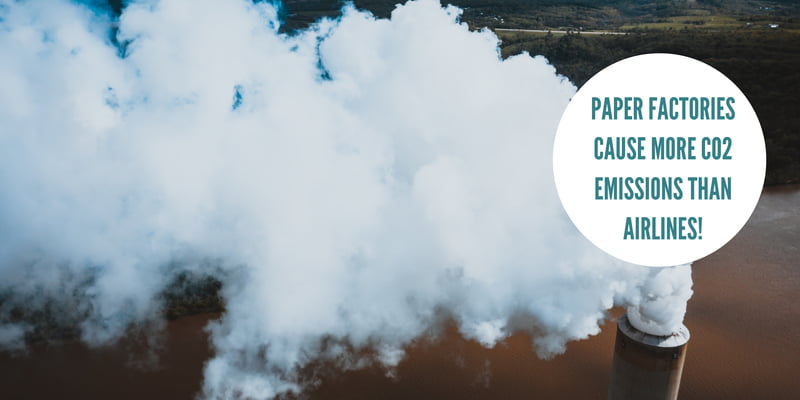
The production of new paper has a significant negative impact on the environment. Ancient forests or agricultural lands are rapidly being converted into plantation forests for paper production. Plantation forests are a monoculture that does not contribute to biodiversity. These plantation forests are often FSC certified, leading the market to believe the paper is sustainable. Furthermore, paper production requires a lot of energy. Many may not be aware (yet), but the emissions from the total paper industry are now greater than those of aviation (source)!
The more paper we reuse, the smaller the environmental impact will be. Paper has been recycled for over a thousand years. Initially, this was done primarily for economic reasons: all the energy, water, raw materials, and labor already invested in new paper did not need to be reinvested, making recycling attractive. Today, that is no longer the primary motivation for recycling paper. Sustainability has become increasingly important, and recycling raw materials is a better option from an environmental perspective. This is currently the main reason for the high interest in recycled paper.
But that does mean you must recycle paper. Because if paper is not recycled and ends up in the trash instead, it finishes where other waste does: in incinerators or landfills. Everyone understands that what you burn is gone forever—gone is the potential raw material, gone is the opportunity to achieve the best environmental benefit. As soon as paper ends up in landfills, the damage becomes even greater. Landfills, which many countries worldwide still use, are a major source of methane emissions into the atmosphere. Like CO2, methane is a greenhouse gas, but it is 25 times stronger and therefore more negative for global warming. Paper and paperboard are organic materials, which causes a lot of methane gas to be released during decomposition (source). Therefore, both incineration and landfills are absolutely not environmentally friendly.
HOW IS RECYCLED PAPER MADE?
Recycled paper can be made relatively easily, with end products that can easily compete in quality with those made from new materials. The days when recycled paper was easily recognizable by its color are long gone. Recycled paper can also be bright white and is almost indistinguishable from new paper. To produce recycled paper, several steps must be taken.
Used paper is collected from businesses and consumers by waste processors and paper collection companies. This waste paper stream is taken to recycling companies where paper sorting takes place. The paper and paperboard are separated and divided into different types and quality classes. This is done according to the EN 643 standard. Subsequently, the paper sorting companies sell the waste paper to the paper mills. Not every paper mill can simply recycle paper. Waste paper must first be cleaned. All inks, staples, paperclips, glue residues, window film, plastic, sand, and dust must be removed.
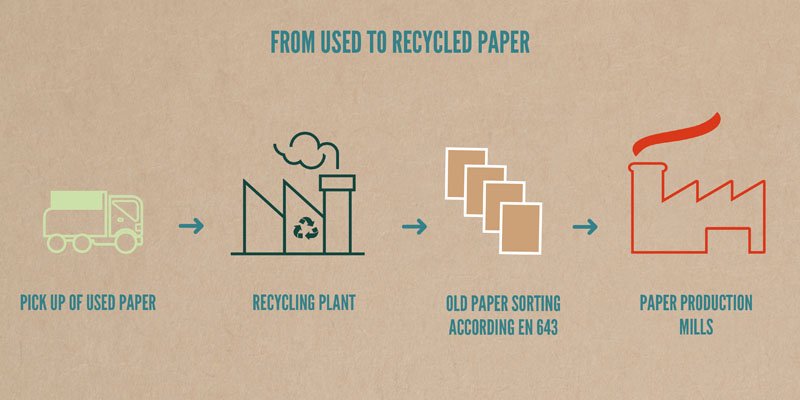
A paper mill must therefore be designed to process waste paper into recycled paper. Cleaning waste paper is somewhat like a washing machine. The contaminated waste paper is collected in a large tank and mixed with water and a type of soapy water. This process is called paper pulping. The paper pulp is then cleaned through various filters, screens, and separation techniques. Ultimately, just over 99% water and 1% cellulose fibers remain. These cellulose fibers are sprayed onto the screen of the paper machine in the paper mill. The thicker the layer of paper on the screen, the heavier the grammage per square meter.
By adding different substances to the paper pulp and through the chosen mix of waste paper types, various paper products can be made, such as tissue paper, printing paper, newsprint, wet-strength paper, folding board, and corrugated board. Paper machines come in different sizes. The largest are over 400 meters long, producing rolls of paper up to 11 meters wide. The rolls of paper coming off these machines weigh as much as 70 tons. The paper is then cut into desired roll widths and large-format sheets for delivery to wholesalers, printers, and packaging companies.
HOW OFTEN CAN PAPER BE RECYCLED?
It is a misconception that paper and paperboard can be recycled indefinitely. Most articles on “paper recycling” mention the number 7 as the number of times paper can be recycled. As soon as waste paper arrives at the paper recycling plant, it must first be wetted and soaked. This happens in the pulper, a large steel tank with a rotor in the center. For each production batch, several thousand kilograms of waste paper of varying quality are placed in the pulper. Water is added, and then the rotor starts to spin—essentially a large mixing machine. Due to the rotation, the paper rubs against the rotor and against each other, creating friction and heat. During this process, the cellulose fibers can become detached from the dirt, but the cellulose fibers also break.
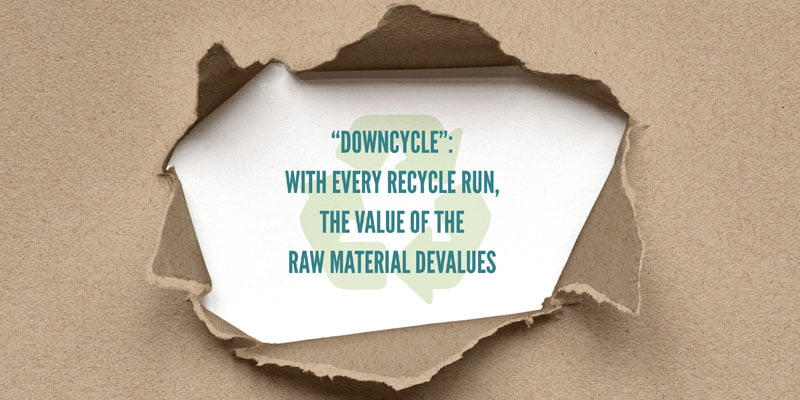
Cellulose fibers that remain long enough are recycled into recycled paper, while fibers that are too small and short are filtered out of the system along with ink residues. Every time waste paper is recycled, a portion of the waste paper is lost. This explains why the paper industry writes that waste paper can be recycled 7 times. This is therefore a theoretical figure. Actually, the words “paper recycling” are not entirely accurate. We should really call the process of paper recycling “paper downcycling.” The value of the waste paper raw material devalues every time it is recycled. And that explains why we cannot use recycled paper alone. New, fresh, long cellulose fibers must always be present in the paper recycling raw material chain.
IS RECYCLED PAPER FOOD-SAFE?
No, basically recycled paper is not food-safe. Waste paper contains contaminants in the form of inks, staples, paperclips, glue residues, window film, plastics, food residues, sand, dust, etc. Because the paper mill is only interested in cellulose fibers (from which paper can be made again), the paper mill only removes substances that are not cellulose fibers. This purification process works quite well, but not 100%. Ink residues, in particular, are very difficult to separate from the fibers. Inks are chemical raw materials containing heavy metals and harmful chemicals. You can imagine that if the paper industry cannot guarantee 100% phasing out of these substances, this recycled paper may not come into contact with food. All paper and paperboard packaging that makes direct contact with food must either be made of 100% new clean cellulose fibers, or there must be a protective layer between the food and the paper or paperboard, such as a plastic or aluminum layer.
WISE WITH WASTE: IT CAN BE EVEN MORE ENVIRONMENTALLY FRIENDLY WITH PAPERWISE PAPER
It is clear that recycling paper is good for our planet. The environmental impact is smaller than that of paper made from trees, and reusing raw materials is positive. But there is a method that is even more environmentally friendly: paper made from agricultural waste.
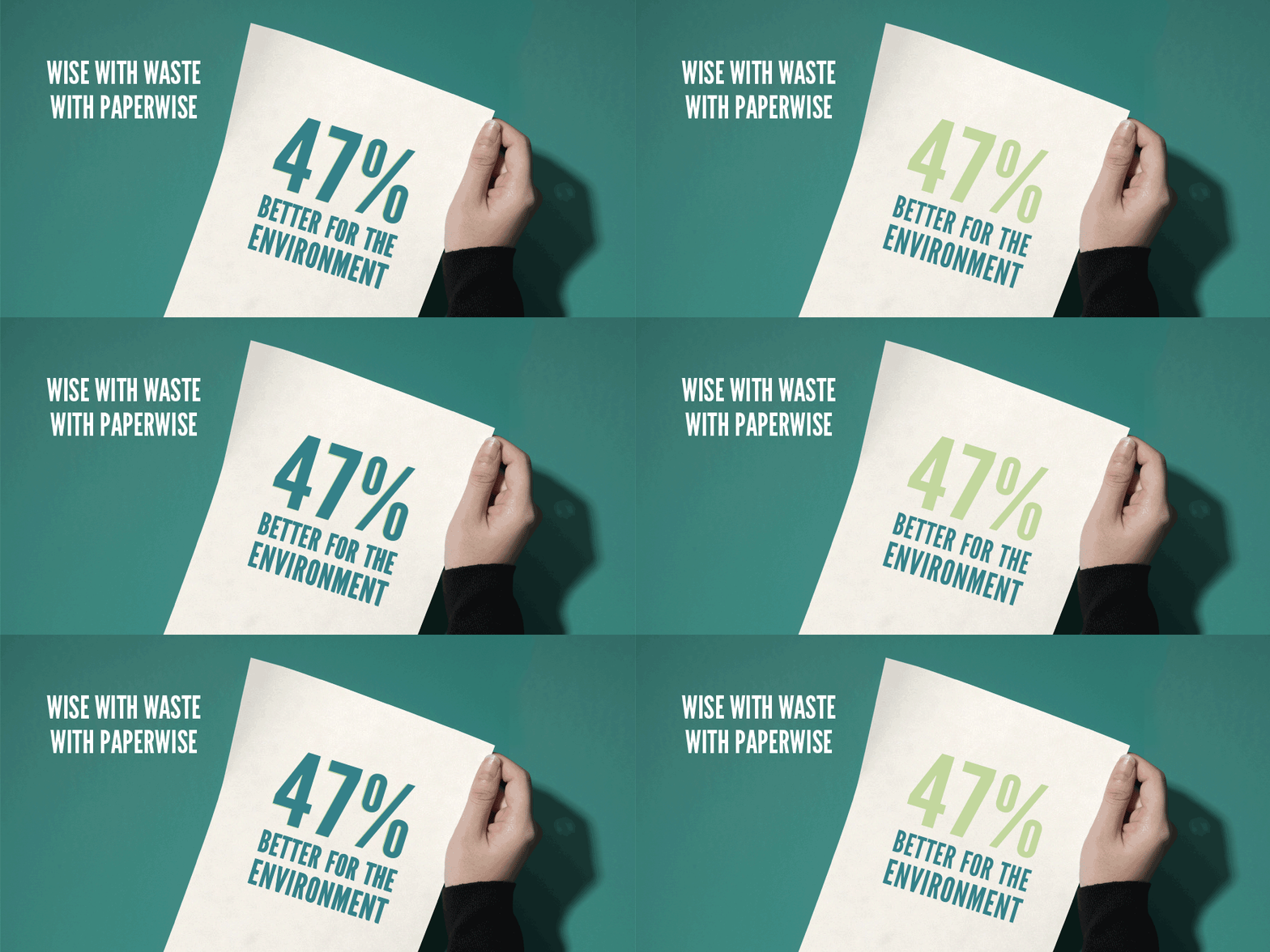
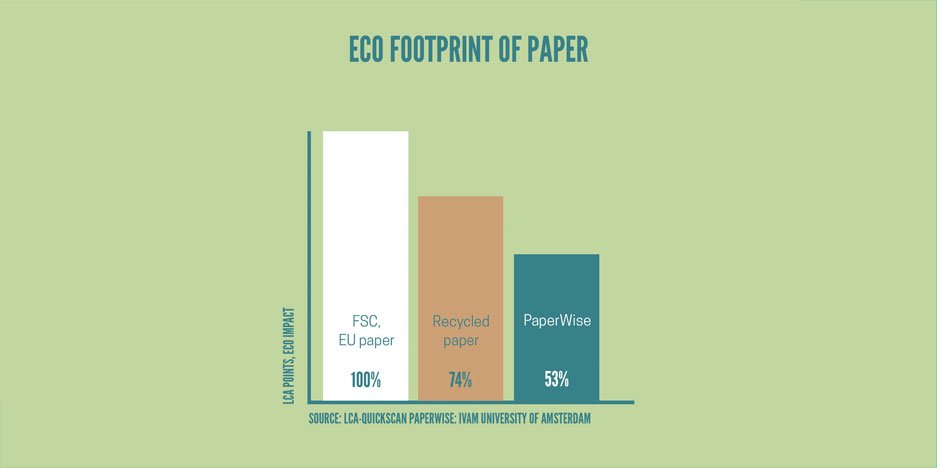
The vision of PaperWise is ‘Wise With Waste’. Much agricultural waste is burned worldwide, even though it can also be processed into a perfect raw material for paper. PaperWise has therefore started making paper and paperboard from this agricultural waste. The stems and leaves left on the land after the harvest are used to produce high-quality paper and paperboard in an environmentally friendly way. Agricultural waste that would otherwise be burned is given a second life in this way, allowing users of this paper to reduce their ecological footprint compared to recycled paper or paper made from trees. Independent environmental research shows that the environmental impact of PaperWise is 29% lower than that of recycled paper and even 47% lower than that of paper made from trees (new paper).
Thanks to PaperWise paper, plantation forests for the paper industry become redundant. Trees no longer need to be cut down but can remain standing to absorb CO2, which is converted back into oxygen. We can decide for ourselves what we want to do with these pieces of land! Use them for natural forests with a wide variety of life and biodiversity or use them for agricultural land. Isn’t it much smarter to get two products—food and the raw material for paper—from the same plant and the same piece of land?
CAN PAPERWISE PAPER ALSO BE RECYCLED?
Yes, certainly. PaperWise is actually excellent for recycling, up to 7 times. And it can simply be mixed with the normal waste paper stream. PaperWise is not recycled paper, but new pure paper made from cellulose extracted from plant residues left over after the harvest. PaperWise is therefore allowed to come into direct contact with food. Furthermore, this agricultural waste does not compete with human or animal nutrition; it is truly a waste product from agriculture. About 20 percent of an agricultural crop is edible and used as food. The remaining 80 percent consists of non-edible leaves and stems, and that constitutes the waste from which cellulose for PaperWise paper is extracted.
By using agri waste as a raw material, green energy where possible, and CO2 compensation, PaperWise is CO2-neutral paper and paperboard with a very low environmental impact. Without compromising on quality. PaperWise paper meets the highest quality standards and certifications and is suitable for virtually all printing applications. PaperWise therefore guarantees a lifespan of up to 100 years (suitable for archiving). Nevertheless, much paper will not need to be kept that long and will be eligible for recycling after a few years.
IS RECYCLED PAPER STILL THE MOST RESPONSIBLE CHOICE?
In conclusion; with an environmental impact of PaperWise that is 29% lower than that of recycled paper and even 47% lower than that of paper made from trees (new paper), paper from agricultural waste is even more environmentally friendly. We call that Wise With Waste.